
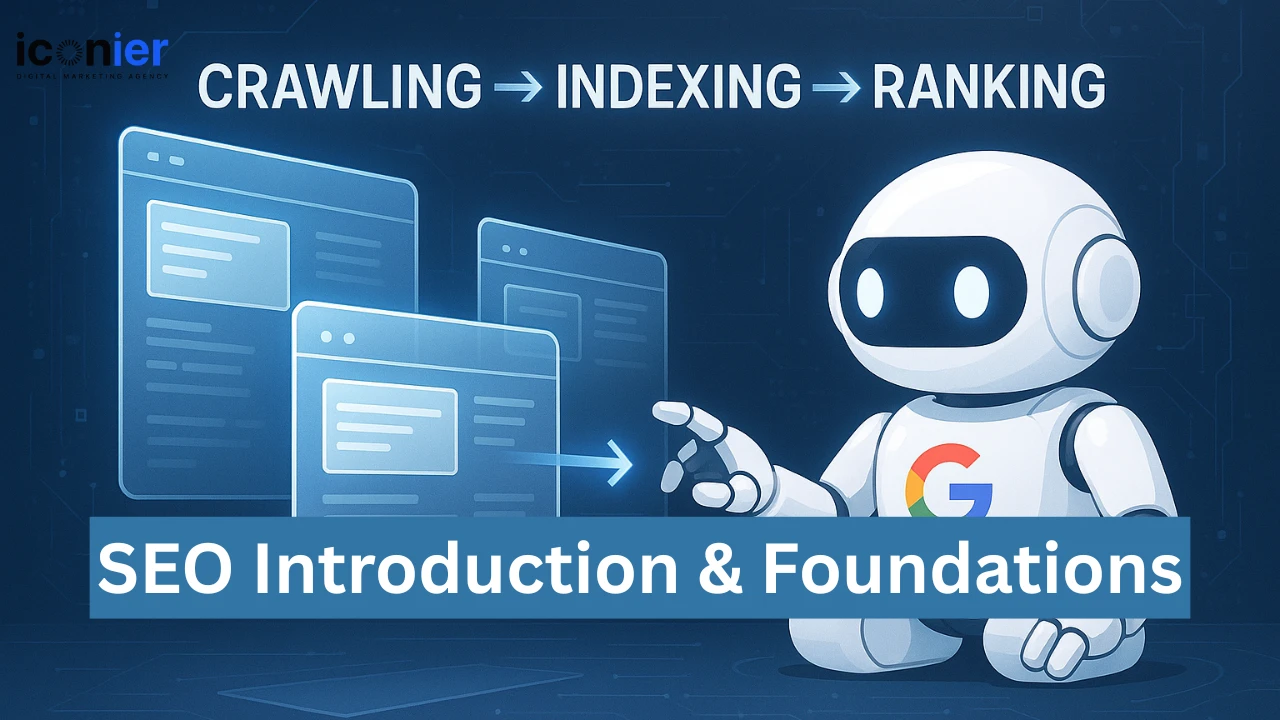
SEO INTRODUCTION & FOUNDATIONS
Before you learn keyword research, backlinks, technical SEO, or advanced strategies — you must understand the foundation of how SEO truly works.
Most beginners try to jump directly into tools or complex strategies. That’s why they fail.
Real SEO starts from understanding search engines, ranking systems, algorithms, and Google’s behavior.
This module walks you through everything you must know to develop a solid, unshakeable SEO base.
What Is SEO & How Does It Work?
What is SEO?
SEO stands for Search Engine Optimization.
It is the science + art of optimizing a website so it ranks higher on Google for relevant searches.
Example:
If someone searches “best running shoes”, Google shows websites that provide the best answers.
If your website appears in the top 3, you get maximum clicks and conversions.
SEO = bringing organic (free) traffic to your site.
Why SEO Matters in 2026
93% of online experiences start with search
70% of clicks go to the top 3 results
Google processes 8.5 billion queries daily
Businesses rely heavily on search visibility
Paid ads are becoming expensive
AI search is rising but SEO is still the heart of discoverability
Without SEO, your website is invisible.
How SEO Works (Simple Breakdown)
SEO works through three main processes:
A. Understanding what people search for (Intent)
Why is the user searching?
What answers do they expect?
B. Making your content relevant
Using keywords, structured content, headings, clarity, and helpful information.
C. Making your site rank-worthy
Google must trust your site.
This includes backlinks, authority, speed, technical health, UX, etc.
SEO is NOT one-time. It is ongoing.
How Google Decides What to Rank?
Google asks 3 questions:
Is this page helpful? (Content Value)
Is this page trustworthy? (Authority + Backlinks)
Does this page give a good user experience? (Speed + Layout + Mobile)
The better you meet these three, the higher you rank.
Crawling, Indexing, Ranking (How Search Engines Work)
This is the most fundamental thing beginners fail to understand.
1. Crawling — How Google Discovers Your Site
Google uses automated bots called Googlebot to scan the internet.
It follows links → finds pages → scans content → collects data.
If crawling fails, nothing else happens.
Why crawling may fail?
Broken internal links
Blocked by robots.txt
Server errors
Too many pages
Poor site structure
2. Indexing — How Google Stores Your Content
After crawling, Google decides whether to store your page in its index (database).
If your page is NOT indexed → it WILL NOT appear on Google.
Pages are not indexed when:
Thin / duplicate content
Low-quality content
No original value
Canonical issues
Google sees no purpose
Indexing = permission to appear on Google.
3. Ranking — How Google Decides Order of Results
Google ranks billions of pages using hundreds of signals:
Content relevance
Keyword matching
Page quality
Backlinks
Experience
Site authority
Freshness
Technical performance
Search intent
Ranking is dynamic and constantly changing.
Google Algorithm Explained in Depth
Google algorithm is NOT one thing.
It’s a combination of AI systems, ranking models, rules, and quality evaluators.
Below are the major components:
1. RankBrain
Google’s first AI algorithm.
It helps Google understand:
vague queries
incomplete queries
keywords never searched before
user behavior
click patterns
Example:
If people click your page more, RankBrain may push your ranking up.
2. BERT
Helps Google understand the meaning behind sentences.
Example:
“Hotels near me that allow pets”
Google understands:
You want hotel listings
Must accept pets
Must be near your location
3. Helpful Content System
Google rewards content that is:
human-written
expert-created
useful
original
solves a problem
satisfies intent
It punishes AI-only spam, rewritten content, thin content, copied content.
4. SpamBrain
Google’s spam-detection AI.
Targets:
Spam backlinks
Cloaking
Keyword stuffing
Doorway pages
PBN abuse
5. E-E-A-T Consideration
Experience
Expertise
Authoritativeness
Trustworthiness
Not a ranking factor, but a huge influence.
6. Core Updates
Large updates that affect the entire search landscape.
Happen several times a year.
Impact millions of sites.
How Algorithm Uses AI in 2026
Predicts user intent
Understands entities (not only keywords)
Measures content helpfulness
Evaluates UX signals
Detects manipulation
Generates search results (SGE)
200+ Ranking Factors (Explained in Detail)
Although Google has 200+ ranking signals, the major ones are:
1. On-Page Factors
Keyword placement (Title, H1, first paragraph)
Meta tags
Headings
Image alt text
Content quality
Internal links
URL structure
Schema markup
2. Off-Page Factors
Backlinks
Anchor text
Brand searches
Social signals
Digital PR
Citations
Mentions
Backlinks are still the strongest external signal.
3. Technical Factors
Site speed
Mobile-first indexing
Core Web Vitals
HTTPS
Canonicalization
Structured data
Crawl budget
4. User Interaction Signals
Google tracks:
Click-through rate
Time on page
Bounce rate
Return-to-SERP behavior
Scroll depth
If users hate your site → ranking drops.
5. Content Signals
Google checks:
Depth
Accuracy
Originality
Relevance
Freshness
Matching intent
Types of SEO (With Deep Explanation)
1. On-Page SEO
Everything you do ON your website.
Includes:
Keyword optimization
Title, H1, meta
Internal linking
Content optimization
Image SEO
Schema
URL optimization
Goal: Help Google understand your content clearly.
2. Off-Page SEO
Everything done OUTSIDE the website.
Includes:
Backlinks
Brand building
Social media mentions
PR
Guest posting
Influencer collaboration
Goal: Increase authority and trust.
3. Technical SEO
Focuses on website performance and crawlability.
Includes:
XML sitemap
Robots.txt
Page speed
Security
Site architecture
Core web vitals
Canonicals
Indexing
Goal: Help Google crawl, index, and load your site perfectly.
4. Local SEO
Ranking for area-based searches:
“dentist near me”
“best cafe in Delhi”
Includes:
Google Business Profile optimization
Local citations
Reviews
Local keywords
5. Content SEO
Creating content that ranks.
Includes:
Topic clustering
Intent matching
Semantic SEO
Keyword strategy
Long-form guides
FAQ content
White Hat vs Black Hat vs Grey Hat
White Hat SEO
Safe, long-term, Google-approved methods.
Examples:
Quality content
Ethical backlinks
Good UX
Optimized site
Genuine outreach
Black Hat SEO
Risky tactics that break Google’s guidelines.
Examples:
Buying spam links
Keyword stuffing
Cloaking
PBN manipulation
Hidden text
Automated content spam
These lead to penalties.
Grey Hat SEO
Mix of both.
Examples:
Aggressive link building
Mild PBN use
Click manipulation
Expired domains
SEO pros use it carefully but beginners should avoid it.
SEO Trends for 2026 (Very Important)
SEO is evolving faster than ever.
1. AI Search & SGE (Search Generative Experience)
Google’s generative AI creates answers directly.
You must optimize for AI visibility, not just blue links.
2. Entity-Based SEO
Google now ranks topics, brands, and entities — not keywords alone.
Example:
“Virat Kohli age” → Google knows Virat Kohli is an entity.
3. Topical Authority
If your site covers an entire topic deeply, Google sees you as an expert.
4. Helpful Content First
Google rewards content written by:
Experts
Real people
Based on experience
5. Video Search Optimization
YouTube is a major search engine.
Video + blog ranking together increases visibility.
6. Voice Search
Queries are now conversational:
“Which AC is best for Indian summers?”
7. Semantic SEO
Google understands topics, not keyword stuffing.
Conclusion: Your SEO Foundation Starts Here
Module 1 has given you the most crucial understanding of SEO — the part that many beginners skip, but professionals rely on every single day.
You now understand the core logic behind Google, the science of ranking, and the principles that shape modern search behavior.
Before this module, SEO may have felt like a confusing mix of keywords, backlinks, and tools.
But now you know that SEO is built on:
-
How search engines crawl, index, and rank pages
-
How algorithms judge quality and intent
-
How technical performance and user experience influence visibility
-
How authority, trust, and content depth shape your rankings
-
How AI, entities, and SGE are transforming SEO in 2026 and beyond
With these fundamentals, you are no longer guessing.
You are thinking like a search engine — and that is the mindset that creates real SEO experts.
What You Should Take Away from This Module
✔ SEO is not just keyword placement — it’s understanding how Google thinks
✔ Crawling + Indexing + Ranking = The backbone of search visibility
✔ Algorithms change, but Google’s goal remains the same: Serve the best result
✔ Authority, relevance, and experience shape every ranking
✔ White-hat SEO builds long-term growth
✔ AI search is the future — but fundamentals remain powerful
✔ SEO offers massive career potential and income opportunities
This module gives you the foundation, the language, and the mindset needed to grow into a confident SEO professional.
Final Words
If you master the foundations taught in this module, you will be ahead of 90% of beginners who try SEO without understanding the basics.
These fundamentals will guide you through every future module, every SEO project, and every website you optimize.
Your SEO journey has officially begun.
From here, we take it to the next level.
Social Share
Have a project to discuss? We are Ready

Rishabh Sharma (Rish)
Founder, ICONIER Inc.
Over 11 years of experience in managing digital products with a specific focus on branding, lead generation, and delivering custom IT Solutions. Graduated from the University of London (U.K) in Business & Management. Rish saw the opportunity to improve and digitalize operations for small and large businesses by providing simple and innovative online solutions.