
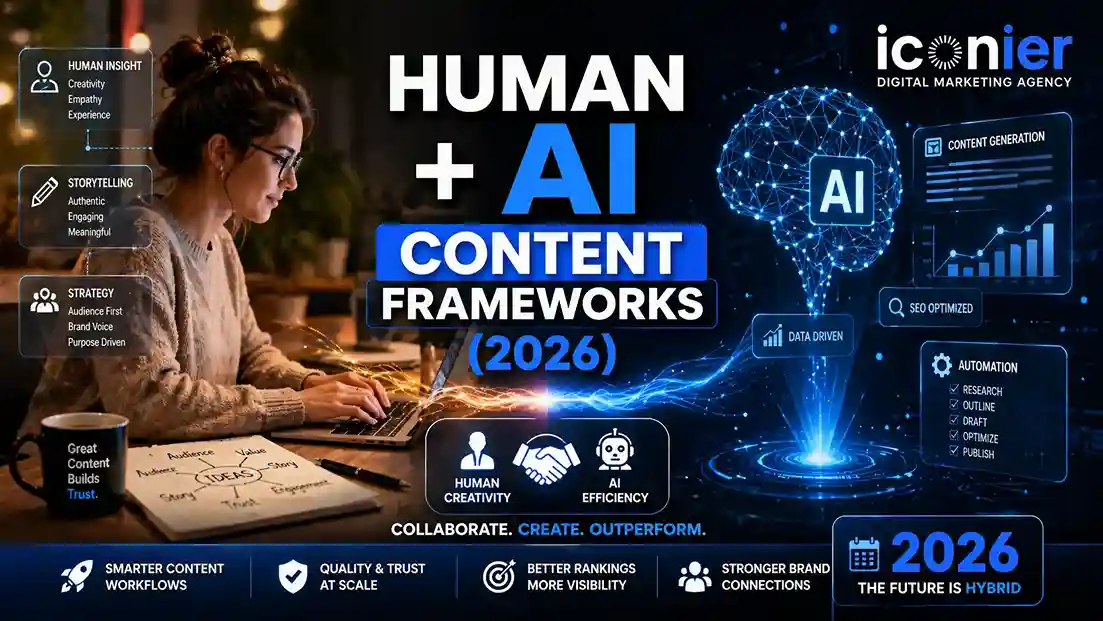
There’s a quiet shift happening in SEO right now—and most businesses haven’t caught up. You’ll still find thousands of articles pumped out using AI content writing, optimized with keywords, formatted nicely… and yet, they don’t rank. Or worse—they rank briefly, then disappear. The problem isn’t AI. The problem is how it’s being used. If your SEO content strategy 2026 still treats AI as a shortcut instead of a system, you’re building content that looks complete but lacks one critical factor: trust. This is where AI content frameworks—built on a smart human and AI content strategy—start to separate content that ranks from content that gets ignored. Let’s break down what actually works now.
What Changed in 2026: Why Trust Beats Volume
A few years ago, content success was mostly about publishing consistently and targeting the right keywords. That approach doesn’t hold up anymore.
Search engines now prioritize:
- Real expertise
- Clear intent alignment
- Depth over volume
- Genuine usefulness
This shift is heavily influenced by the Google helpful content update, which pushed low-value, generic content out of search results. Today, high-quality content SEO isn’t about saying more—it’s about saying something worth reading.
And that’s where EEAT content strategy comes in:
- Experience: Have you actually done what you’re writing about?
- Expertise: Do you understand the topic deeply?
- Authority: Do you provide insights others don’t?
- Trust: Can readers rely on your content?
AI alone can’t deliver that. But combined with human input, it becomes powerful.
What Are AI Content Frameworks (Really)?
Most people misunderstand AI content frameworks. They think it’s about generating a blog post using a prompt and hitting publish. That’s not a framework—that’s automation. A real framework is a structured system where:
- AI handles speed and expansion
- Humans control direction, depth, and credibility
This is what AI-assisted content writing is supposed to look like.
Instead of asking:
“Can AI write this for me?”
You start asking:
“Where should AI support me in this process?”
That shift alone improves content quality dramatically.
The Human + AI Content Strategy That Actually Works
A strong human and AI content strategy isn’t complicated—but it is intentional.
Think of it in three layers:
- 1. Human Strategy Layer
This is where content wins or loses before it’s even written.
You define:
- Who the content is for
- What problem does it solve
- What intent idoes t target
Without this, even the best AI content tools strategy will produce shallow results.
- AI Execution Layer
This is where AI helps you move faster.
You use it for:
- Expanding ideas
- Structuring sections
- Drafting initial content
But here’s the key: AI should generate material—not finalize it.
- Human Trust Layer
This is the most overlooked step—and the most important.
You refine content by:
- Adding real insights
- Clarifying explanations
- Removing generic fluff
- Improving readability
This is where content trust signals SEO is built.
Step-by-Step Human + AI Content Framework
If you’re wondering how to write SEO content with AI that actually ranks, this is the process.
- Step 1: Start With Intent, Not Keywords
Before writing anything, define:
- What is the user really looking for?
- Are they learning, comparing, or buying?
This is the foundation of user intent content writing.
Instead of chasing isolated keywords, focus on semantic SEO writing—covering the full topic naturally.
- Step 2: Build a Strategic Outline
Don’t rely on AI to generate your structure blindly.
A strong outline should:
- Flow logically
- Answer key questions
- Cover depth without repetition
This is where many competitors fall short—they produce content that feels “full” but lacks direction.
- Step 3: Use AI for the First Draft (Smartly)
This is where AI assisted content writing shines.
Use AI to:
- Expand bullet points
- Generate variations
- Fill structural gaps
But avoid copying outputs directly. Raw AI drafts often sound complete—but lack clarity and originality.
- Step 4: Edit Like a Human, Not a Machine
This step defines your content quality.
Improve:
- Sentence flow
- Clarity
- Depth of explanation
Add:
- Examples
- Observations
- Practical insights
Remove:
- Repetitive phrases
- Vague statements
- Generic transitions
This is where content quality optimization actually happens.
- Step 5: Optimize for SEO (Without Overdoing It)
Modern content optimization SEO is subtle.
Focus on:
- Natural keyword placement
- Internal linking
- Clear headings
- Readable formatting
Prioritize natural language content SEO—write the way people actually read.
- Step 6: Add Trust Signals (This Is Where Rankings Happen)
Most content fails here.
Strong content trust signals SEO include:
- Clear, confident explanations
- Unique perspectives
- Structured answers
- Consistent tone
If your content feels like it could be written by anyone, it won’t rank long-term.
- Step 7: Final Quality Check
Before publishing, ask:
- Is this genuinely helpful?
- Does it answer the query better than others?
- Would I trust this if I found it online?
That’s the standard for helpful content SEO today.
Why Trust Signals Are the New Ranking Factor
You won’t find “trust signals” as a direct metric—but they influence everything.
Content that performs well usually:
- Feels clear and intentional
- Avoids fluff
- Provides real value quickly
In contrast, low-performing content often:
- Over-explains simple ideas
- Repeats information
- Lacks depth
The difference isn’t technical—it’s perceptual.
Semantic SEO + AI: Cover More Without Sounding Repetitive
One of the biggest advantages of AI is expanding topic coverage.
With the right approach, you can:
- Address related subtopics
- Answer follow-up questions
- Build authority across a subject
This is the essence of content marketing SEO today.
Instead of writing for a keyword, you write for a topic.
Content Personalization: The Edge Most People Ignore
Not every reader is the same.
Some are:
- Beginners looking for clarity
- Business owners looking for a strategy
- Professionals looking for depth
Strong content personalization SEO adjusts tone and structure accordingly.
AI helps here by:
- Generating variations
- Adapting explanations
- Supporting multiple angles
But again, human judgment decides what stays.
Common Mistakes That Kill AI Content Rankings
Even well-written content can fail if it falls into these traps:
- Over-reliance on automation
- No human editing
- Keyword stuffing
- Generic tone
- No clear value
If your content sounds like everything else online, it won’t stand out—no matter how optimized it is.
Best AI Content Writing Strategies That Actually Work
If you want results, simplify your approach.
Use AI for:
- Research assistance
- Idea expansion
- Draft structuring
Use human input for:
- Insight
- clarity
- trust
The best AI blogging tips aren’t about tools—they’re about balance. This is what separates scalable content from impactful content.
A Simple Before vs After Example
AI-Only Version:
- Structured well
- Keyword-optimized
- Easy to read
→ But forgettable
Human + AI Version:
- Clear and structured
- Insightful and specific
- Built around real intent
→ Memorable and rank-worthy
The difference isn’t huge—but it’s enough to change performance completely.
The Future of SEO Content Strategy
AI is no longer a competitive advantage—it’s a baseline.
What will define success:
- Original thinking
- Clear communication
- Trust-driven content
The brands that win won’t publish more—they’ll publish better.
Conclusion: Content That Ranks Is Engineered, Not Generated
There’s no shortage of content online. What’s missing is content that feels intentional, useful, and trustworthy. That’s what a strong AI content framework approach delivers.
When you combine:
- Smart AI-assisted content writing
- A clear human and AI content strategy
- And a focus on high-quality content SEO
You don’t just create content—you create assets that perform.
Ready to Build Content That Actually Ranks?
If you’re serious about improving your content optimization SEO and creating high-trust content that stands out in 2026, it’s time to stop guessing and start using a proven system. At Iconier, we don’t just write content—we build strategy-driven, EEAT-focused content systems that are designed to rank, convert, and scale. Whether you’re a startup or an established brand, our team helps you implement the right AI content frameworks without losing the human touch that search engines—and users—trust. Let’s build content that works.