In today’s highly competitive digital landscape, getting your business noticed online is no longer optional—it is a necessity. Every business owner wants to increase visibility, attract qualified leads, and grow revenue.
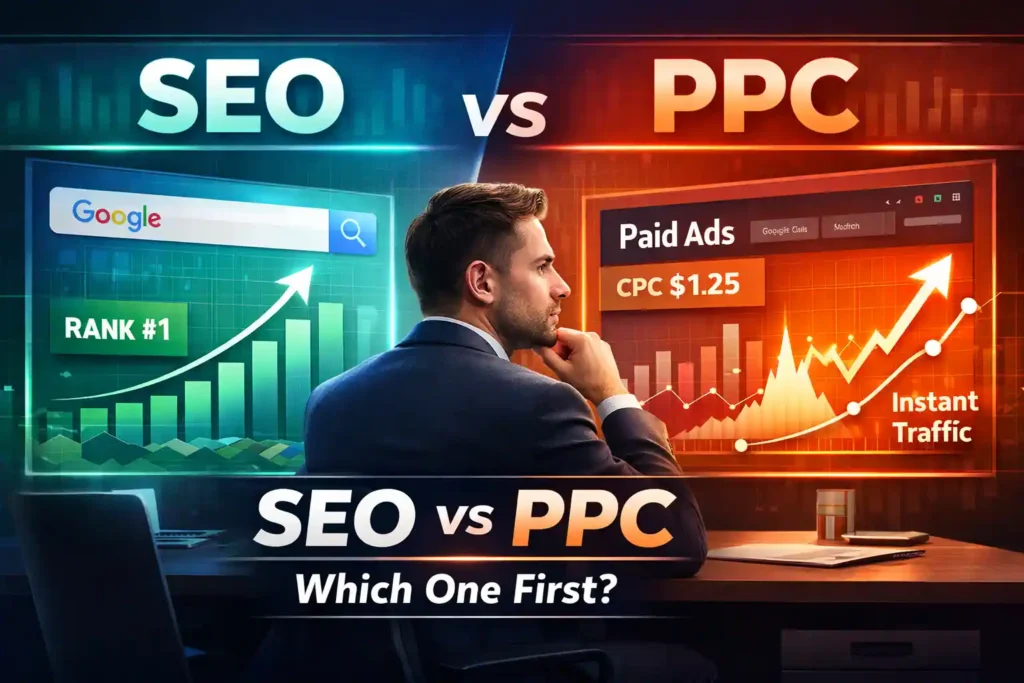
However, when planning an online marketing strategy, business owners frequently run into a common dilemma: should I invest in SEO or PPC first? Making the right digital marketing investment is crucial for your bottom line. Both Search Engine Optimization (SEO) and Pay-Per-Click (PPC) are powerful tools for driving traffic to your website, but they operate on completely different timelines, budgets, and mechanisms.
In this comprehensive guide by Iconier Digital Marketing Agency, we will break down the difference between SEO and PPC, compare their benefits, and help you decide which approach aligns best with your business goals.
What is SEO?
Search Engine Optimization (SEO) is the practice of optimizing your website to rank higher in unpaid, organic search engine results pages (SERPs).
When potential customers search for products or services related to your business, a strong SEO strategy ensures that your website appears at the top of those results naturally. Google algorithms analyze hundreds of factors, including keyword relevance, content quality, backlink profile, and user experience, to determine your search engine rankings.
Unlike paid ads, the clicks you receive from SEO are essentially free. However, earning that top spot requires time, consistent effort, and high-quality content. A robust SEO campaign focuses on building a foundation for long-term digital marketing strategy success.
By consistently delivering valuable content and optimizing technical elements, you generate compounding organic traffic that continues to deliver leads long after the initial work is done.
Key Benefits of SEO
- Builds long-lasting brand authority and trust.
- Provides sustainable, continuous traffic.
- Highly cost-effective in the long run.
- Drives high-intent users actively searching for your solutions.
What is PPC Advertising?
Pay-Per-Click (PPC) is a model of paid search advertising where you pay a fee each time a user clicks on your ad.
The most common platform for this is a Google Ads campaign, which allows you to bid on specific keywords. When a user searches for those keywords, your ad appears at the very top of the search results, tagged as “Sponsored.”
The primary advantage of PPC is instant visibility. The moment your campaign goes live, your website is placed directly in front of your target audience. This makes it an incredibly powerful tool for immediate lead generation and sales.
Furthermore, PPC offers unmatched budget control. You decide exactly how much you want to spend per day, who sees your ads (based on demographics, location, and interests), and which specific landing pages they are directed to.
Key Benefits of PPC
- Immediate traffic and rapid lead generation.
- Highly targeted audience segmentation.
- Complete control over ad spend and daily budgets.
- Easy to track, measure, and scale.
Key Differences Between SEO and PPC
To truly understand search engine optimization vs pay per click, we need to look at how they compare across critical business metrics.
Here is a clear breakdown of the SEO vs PPC cost comparison, speed, and overall strategy.
| Feature | SEO (Search Engine Optimization) | PPC (Pay-Per-Click) |
| Cost | Free clicks, but requires investment in content, time, and optimization. | Pay for every click. Requires ad spend budget and management fees. |
| Speed of Results | Slow (typically 3 to 6 months to see significant movement). | Immediate (traffic starts as soon as the campaign is launched). |
| ROI | Compounding and high over the long term. | Direct and measurable, but stops when ad spend stops. |
| Strategy Type | Long-term brand building and organic authority. | Short-term tactical marketing and immediate conversions. |
| Traffic Sustainability | Highly sustainable. Traffic remains steady even if you reduce effort temporarily. | Unsustainable without a budget. Traffic drops to zero the moment ads are paused. |
When Should You Invest in SEO?
If you are evaluating SEO or PPC for small business growth, SEO is generally the foundation of a lasting online presence. You should prioritize SEO if your primary goal is sustainable, long-term growth.
When you invest in SEO, you are building digital equity. Over time, as your search engine rankings improve, your website becomes a 24/7 lead generation machine that doesn’t charge you for every visitor.
You should lean toward SEO when:
- You want to establish lasting brand authority in your industry.
- You have a limited marketing budget but possess the time to invest in content creation.
- You want to capitalize on the long-term benefits of SEO vs PPC advertising by lowering your overall cost-per-acquisition (CPA).
- Your goal is to build sustainable traffic that outlasts your immediate marketing budget.
When Should You Invest in PPC?
While SEO is a marathon, PPC is a sprint. SEO vs paid advertising isn’t about one being inherently better; it’s about timing.
PPC is the ideal choice when you need rapid results and have the budget to support it. Comparing SEO vs Google Ads, the latter gives you the power to bypass the wait time associated with organic ranking.
You should prioritize PPC when:
- You are a new business that needs immediate cash flow, visibility, and quick leads.
- You are running time-sensitive promotions or product launches.
- You want to target highly specific demographics, locations, or times of the day.
- You want to test new keywords or product ideas quickly before committing to a long-term SEO strategy.
SEO vs PPC ROI Comparison
When making a digital marketing investment, Return on Investment (ROI) is the ultimate deciding factor.
In an SEO vs PPC ROI comparison, PPC typically offers a linear return. If you spend $1,000 and get $3,000 in sales, your ROI is clear and immediate. However, to maintain those sales, you must keep spending that $1,000.
SEO, on the other hand, offers a compounding ROI. You might spend $1,000 a month on SEO for six months before seeing a major return. But once your pages rank at the top of Google, they can bring in thousands of dollars in revenue for years with only minimal maintenance costs. Ultimately, SEO provides a much higher long-term ROI, while PPC excels at short-term predictability.
The Best Strategy: Combining SEO and PPC
The truth is, asking “SEO vs PPC which is better?” often misses the bigger picture. For a truly dominant lead generation strategy, the answer is rarely one or the other.
Knowing when to use SEO and PPC together is the hallmark of a mature marketing campaign. By combining both, you can dominate the search results—appearing in both the sponsored ads at the top and the organic results right below them.
Furthermore, you can use immediate data from your PPC campaigns to identify high-converting keywords, and then funnel those insights into your long-term SEO strategy to capture that traffic organically in the future.
How Iconier Helps Businesses Choose the Right Strategy
At Iconier Digital Marketing Agency (www.iconier.com), we understand that no two businesses are exactly alike.
Whether you are debating SEO vs PPC for small business marketing or looking to scale an enterprise brand, our team of experts is here to help. We analyze your industry, competitors, budget, and timelines to craft a customized online marketing strategy.
From building high-converting Google Ads campaigns for instant wins to executing advanced, LLM-optimized SEO strategies for long-term dominance, Iconier ensures your marketing budget is invested exactly where it will yield the highest returns.
Conclusion
The debate between SEO and PPC ultimately comes down to your business goals, budget, and timeline.
If you need immediate traffic, quick sales, and highly targeted visibility, PPC is your best starting point. If you want to build a sustainable online presence, establish brand authority, and enjoy compounding ROI, SEO is the mandatory long-term play.
For the best results, businesses should ideally leverage both: using PPC for short-term wins while simultaneously building their SEO foundation for future growth. Ready to dominate the search engines? It’s time to define your strategy and start growing.
Frequently Asked Questions (FAQs)
Neither strategy is universally "better." SEO is superior for long-term, cost-effective growth and brand authority. PPC is better for immediate visibility, rapid lead generation, and highly targeted, time-sensitive campaigns.
It depends on cash flow. If a small business needs immediate revenue to survive, starting with a tightly controlled PPC campaign is wise. However, they should simultaneously begin basic SEO work, as relying solely on PPC becomes expensive over time.
PPC generates traffic instantly the moment your campaign goes live and your bids are accepted. SEO is a gradual process that typically takes 3 to 6 months to start showing significant improvements in traffic and rankings.
Yes, combining them creates the strongest digital marketing strategy. You can use PPC to drive immediate sales while your SEO rankings build, use PPC keyword data to guide your SEO content, and dominate search pages by appearing in both paid and organic spots.
Social Share
Have a project to discuss? We are Ready

Rishabh Sharma (Rish)
Founder, ICONIER Inc.
Over 11 years of experience in managing digital products with a specific focus on branding, lead generation, and delivering custom IT Solutions. Graduated from the University of London (U.K) in Business & Management. Rish saw the opportunity to improve and digitalize operations for small and large businesses by providing simple and innovative online solutions.


